

 Contact Us
 Internal
 Japanese
 Font Size
 Font Size


[Research] Belle II accumulates the world’s largest Υ(4S) dataset for more precise searches for new physics beyond the Standard Model
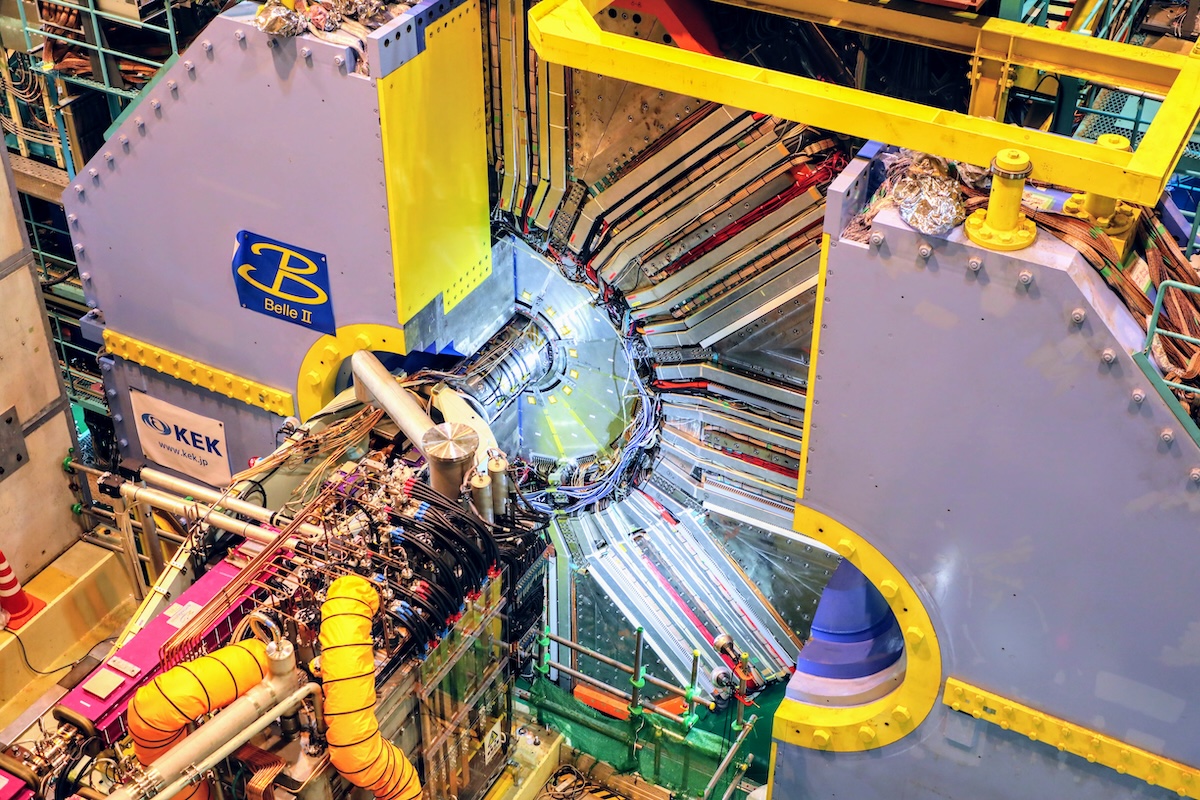
The Belle II experiment reached a major milestone on May 17, 2025, by accumulating the world’s largest dataset of B mesons. This achievement surpasses the record set by its predecessor, the Belle experiment. By utilizing “clean” electron–positron annihilation processes (in which few additional particles are produced), Belle II can probe signs of new physics beyond the Standard Model with unprecedented precision.
Looking ahead, the research team will continue to increase the dataset and refine the experimental apparatus, aiming to open a new era in particle physics and deepen our understanding of the mysteries of the universe.
You may find more details in the press release from KEK.
Key to Solving the Mysteries of the Universe: Exploring Physics Beyond the Standard Model
The main focus of the Belle II experiment is a field known as flavor physics, which studies the behavior of different types (“flavors”) of particles such as quarks and leptons, particularly how they decay. While the Standard Model—the current fundamental framework of particle physics—successfully explains many phenomena, important mysteries remain, including the nature of dark matter.
By precisely measuring extremely rare particle decays, Belle II seeks to uncover clues to previously unknown particles or forces that lie beyond the Standard Model.
The experiment’s predecessor, Belle (1999–2010), made a major breakthrough by demonstrating CP violation, a difference in behavior between matter and antimatter. This achievement played a key role in the 2008 Nobel Prize in Physics awarded to Makoto Kobayashi and Toshihide Maskawa.
Observing such rare phenomena requires enormous amounts of data. To meet this challenge, Belle II employs an innovative “nano-beam” scheme, in which the electron and positron beams are squeezed to nanometer-scale sizes at the collision point. Since 2019, the experiment has been steadily operating toward achieving world-leading luminosity (collision rate), enabling the collection of unprecedented volumes of data.
A World Record Achieved by Overcoming Challenges: More Than 2.5 Times the Performance of Belle
This record-breaking achievement is the result of sustained progress and meticulous tuning of the SuperKEKB accelerator and the Belle II detector. By overcoming challenges such as unexplained “sudden beam loss” events that had hindered stable operation, the experiment has achieved reliable, high-power, continuous running.
On March 19, 2026, the instantaneous luminosity (collision rate per unit time) reached a new world record of 5.2 × 1034 cm-2s-1 approximately 2.5 times higher than that of the Belle experiment. Higher luminosity means that more particle collisions occur, allowing data to be collected more efficiently.
As of June 4, 2026, the accumulated dataset at the Υ(4S) (Upsilon-4S) resonance reached 757 fb-1 (inverse femtobarns), surpassing the Belle record of 711 fb-1. The data accumulation rate has also improved significantly, reaching about three times that of the previous experiment on average.
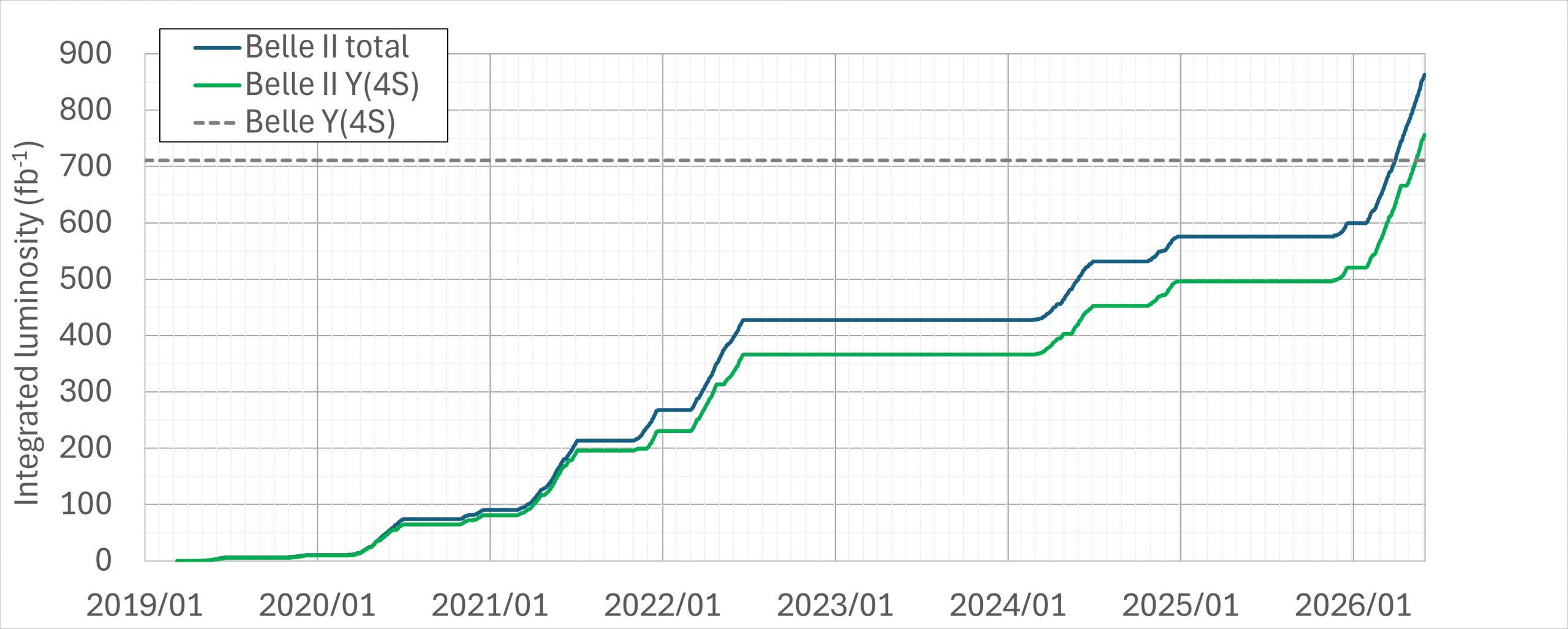
May 2026, Belle II surpassed the full Υ(4S) dataset of the Belle experiment.
© Belle II Collaboration/KEK
Towards the Ultimate Goal of 50 ab-1: Entering an Era of Discovering New Physics
With the world’s largest dataset now in hand, the Belle II experiment has entered a full-fledged era of precision measurements. Going forward, the collaboration will perform detailed analyses of the accumulated data, searching for signs of new physics through processes such as particle decays involving neutrinos.
The next milestone is to achieve a total integrated luminosity of 1 ab-1 (inverse attobarn, equivalent to 1000 fb⁻¹). Ultimately, Belle II aims to collect 50 ab⁻¹ of data—about 50 times larger than that of the Belle experiment.
To reach this goal, major upgrades to both the accelerator and the detector are planned around 2032.
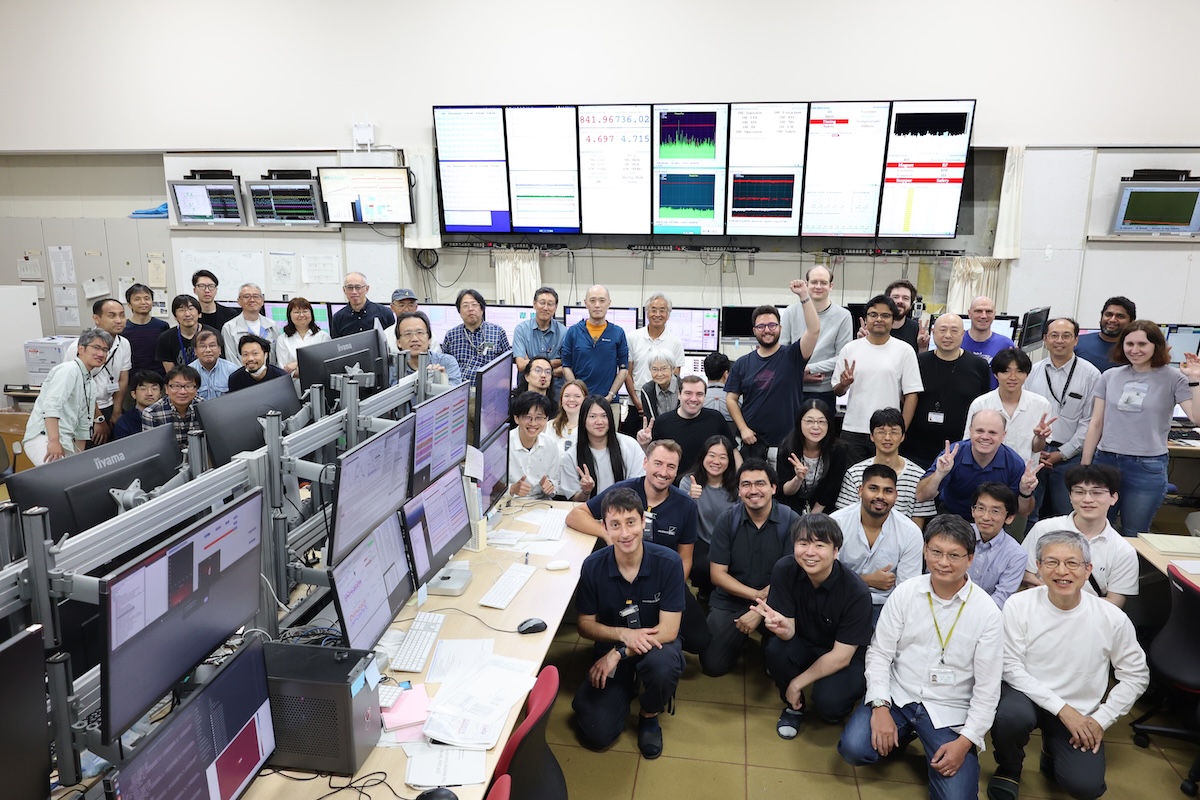
the accumulation of the world’s largest Υ(4S) dataset.
© Belle II Collaboration/KEK
Nagoya University’s Contribution: Particle Identification with the TOP Counter
The High Energy Physics Laboratory (N-Lab) of the Graduate School of Science at Nagoya University has been responsible for the development, construction, and operation of the “TOP counter,” a particle identification detector for the Belle II experiment. This detector plays a crucial role in precisely distinguishing between particles with similar properties, such as pions and kaons, and has demonstrated excellent performance in the Belle II experiment.
It has operated stably even under harsh radiation conditions and has significantly contributed to the high-precision acquisition of data at an unprecedented scale. In addition, the group has contributed to the development of radiation monitors required for improving accelerator performance, as well as to upgrades of the accelerator control system.
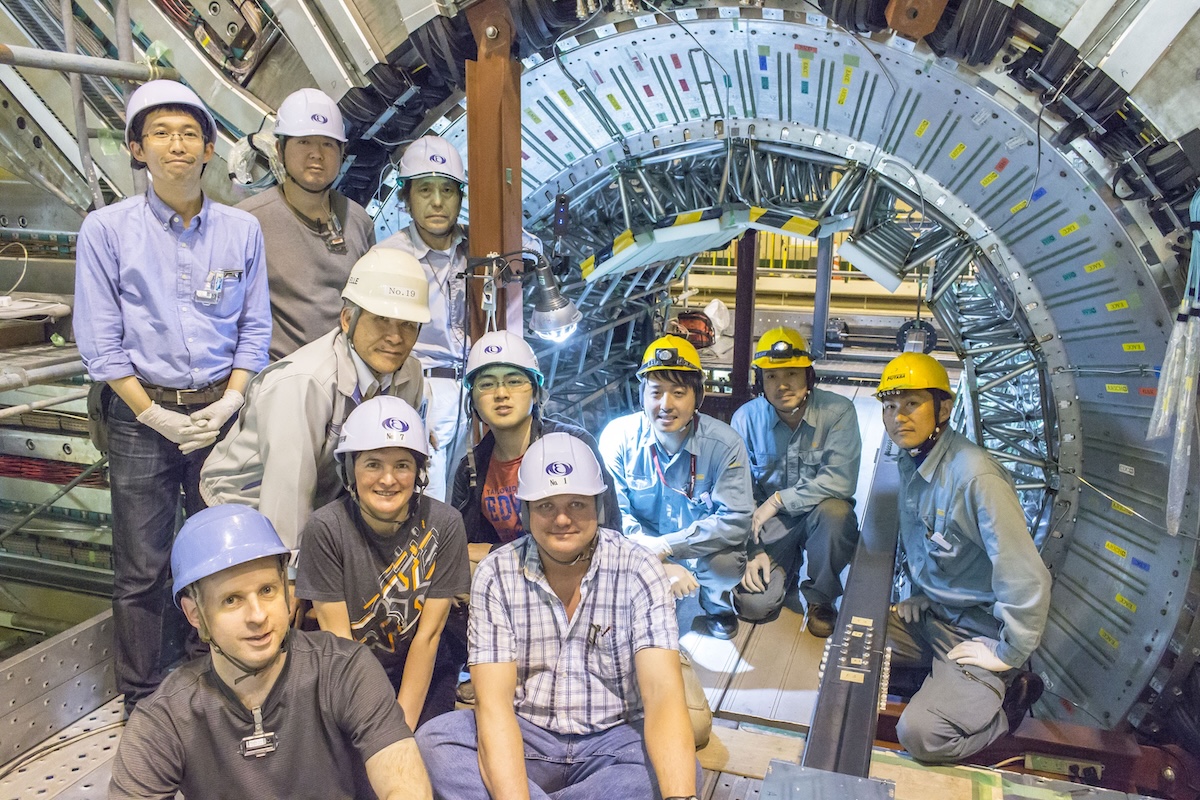
Researcher’s Comment: Kenji Inami
By overcoming challenging conditions and making continuous efforts in the operation and tuning of both the detector and the accelerator, we have succeeded in collecting a dataset that surpasses those of previous experiments. Although data taking is still ongoing, we will use this world-leading dataset to explore new physics.