

 Contact Us
 Internal
 Japanese
 Font Size
 Font Size


Telescoping Physics of the Early Universe & Boosting Education with Research Data & Discoveries
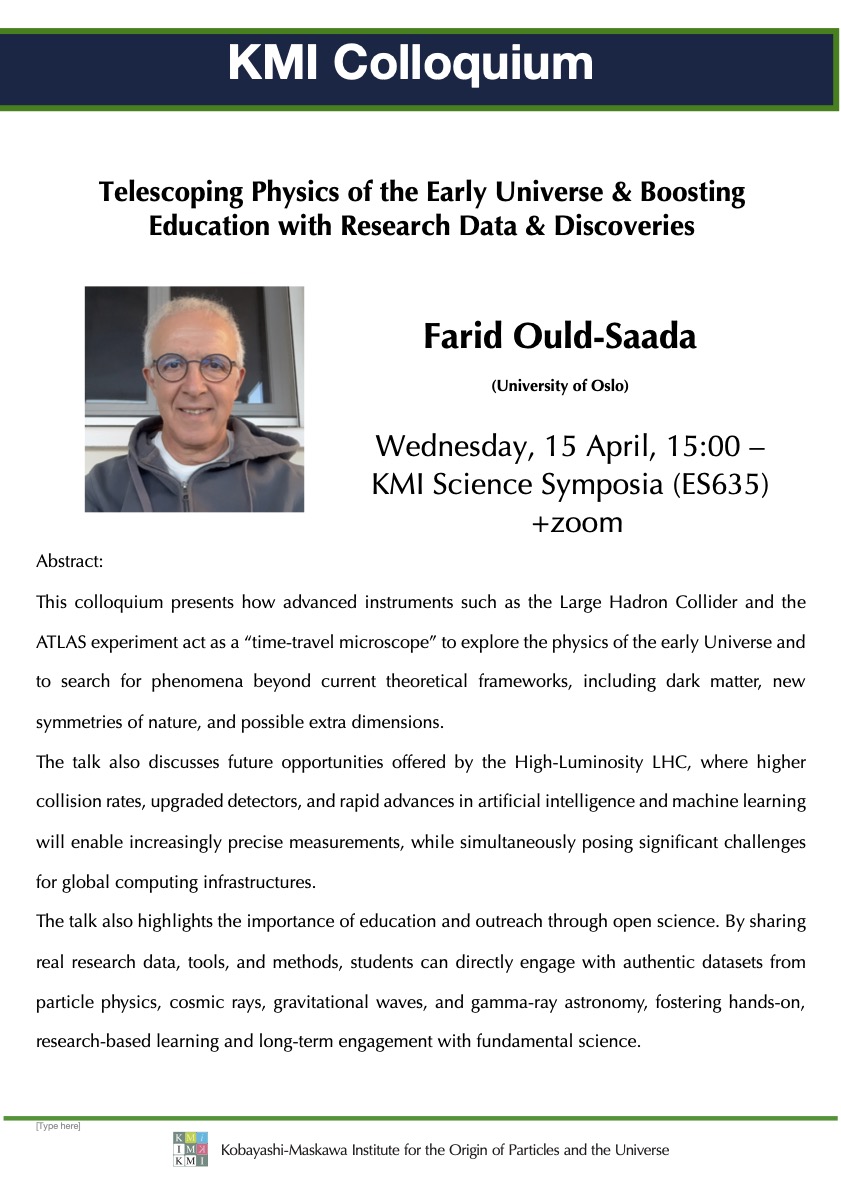
This colloquium presents how advanced instruments such as the Large Hadron Collider and the ATLAS experiment act as a “time travel microscope” to explore the physics of the early Universe and to search for phenomena beyond current theoretical frameworks, including dark matter, new symmetries of nature, and possible extra dimensions.
The talk also discusses future opportunities offered by the High Luminosity LHC, where higher collision rates, upgraded detectors, and rapid advances in artificial intelligence and machine learning will enable increasingly precise measurements, while simultaneously posing significant challenges for global computing infrastructures.
The talk also highlights the importance of education and outreach through open science. By sharing real research data, tools, and methods, students can directly engage with authentic datasets from particle physics, cosmic rays, gravitational waves, and gamma ray astronomy, fostering hands on, research based learning and long term engagement with fundamental science.
本コロキウムでは、大型ハドロン衝突型加速器(LHC)や ATLAS実験といった最先端の観測装置が、「時間を遡る顕微鏡」としてどのように機能し、初期宇宙の物理を探究するとともに、暗黒物質や自然界に潜む新たな対称性、さらには余剰次元の可能性といった、現在の理論的枠組みを超える現象の探索にどのように用いられているかを紹介します。
また、高輝度LHC(High Luminosity LHC)が切り拓く将来の展望についても議論します。衝突率の大幅な向上や検出器の高度化、さらには人工知能(AI)や機械学習の急速な発展により、これまでにない精度での測定が可能となる一方、世界規模の計算基盤には新たな課題が突きつけられています。
さらに、オープンサイエンスを通じた教育・アウトリーチの重要性にも焦点を当てます。実際の研究データや解析ツール、手法を共有することで、学生や生徒が素粒子物理、宇宙線、重力波、ガンマ線天文学などの真正なデータセットに直接触れることができ、体験的かつ研究に基づいた学習を通じて、基礎科学への長期的な関与を育むことが期待されます。